
Equality Is Good for Everyone–Part II

Popular Economics Weekly

Nineteen states will increase their minimum wages on January 1, boosting earnings for more than 8.3 million workers by a total of $5 billion. In addition, 47 cities and counties will raise their minimum wages, adding to the number of workers likely to get larger paychecks because of lawmakers—or in some cases, voters—taking action to lift state and local wage floors.” EPI.org
FREDdeficits

My Happy New Year’s greeting is to those 19 states that increased their minimum wage, and my condolences to those Republican-run red states that haven’t ever increased their minimum wage but relied on the federal minimum wage of $7.25 per hour that was last increased in 2009.

Minimum wage hikes went into effect in 19 states on January 1, 2026: Arizona, California, Colorado, Connecticut, Hawaii, Maine, Michigan, Minnesota, Missouri, Montana, Nebraska, New Jersey, New York, Ohio, Rhode Island, South Dakota, Vermont, Virginia, and Washington.

Only four are Republican red states. The rest of the red states still have the federal minimum wage that is worth just $5.25 per hour in today’s dollars.

The advocacy group One Fair Wage (OFW) said  “According to the MIT Living Wage Calculator, there is no county in the United States where a worker can afford to meet basic needs on less than $25 an hour. Even in the nation’s least expensive counties, a worker with one child would need at least $33 an hour to cover essentials like rent, food, childcare, and transportation.”

Yes, equality is good for everyone, but can this happen in this New Year 2026? We will have to move out of the second Gilded Age that Donald Trump is touting to support his tariffs that has enriched his robber barons.

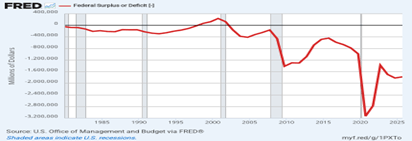
We know how we got here; the huge transfer of wealth beginning in the 1980s with massive Republican tax cuts that is obvious in this historical graph of budget deficits from 1980, when Big Business CEOs took over the running of our government.

Ronald Reagan’s Republicans created the first deficits beginning in 1980. The Clinton administration balanced the budget, creating a federal budget surplus in the years 1997 to 2000.

GW Bush then plunged US back into debt in 2000 with additional massive tax cuts while paying for the invasion of Iraq and Afghanistan. The annual deficits plunged further beginning in 2008 with the need to pay for the 2008-09 Great Recession (large gray bar).

Yet the Obama administration paid the annual deficit back down to its 2004 level. The Trump I era then increased it with more massive tax cuts being paid for once again by the American public. The graph portrays the obvious. The largest annual deficits were created during the years of Republican tax cuts.

More than $9 trillion will be added to the public debt in just the two Trump administrations from the renewal of the Trump tax cuts. So it is obvious that Republicans are mainly responsible for the $36 trillion public debt Americans are saddled with today that must be paid for to maintain the good faith and credit of the U.S. government.

Those tax cuts have benefited the few and lowered the living standard of many Americans, especially in those red states that haven’t raised their minimum wage. So it’s time to pay our enormous debt down that was created by those tax cuts. But that can only happen when enough Americans realize what has been stolen from them.

Can the tide begin to turn in this New Year, another Progressive era and a Teddy Roosevelt appear to end this Gilded Age of corruption? What will it take? Let us hope it won’t be another Great Depression to wake us out of our decline as a democracy.

May this be a Happier New Year!

Harlan Green © 2026

Follow Harlan Green on Twitter: https://twitter.com/HarlanGreen
Posted in Consumers, COVID-19, Economy, Politics, Weekly Financial News | Tagged , , , , , , , , , , , , , | Leave a comment

A Better Economy For Whom?

Popular Economics Weekly

“…in going from the Biden Administration to the Trump Administration, we have traded an economy that disproportionately benefited low-income workers to one that disproportionately benefits the well-off (particularly those who own a lot of stocks).” Paul Krugman

FREDgdp

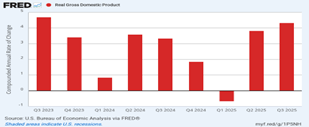
Second and Third quarter Gross Domestic Product growth surged (see graph), mainly due to a jump in consumer spending as shoppers rushed to get ahead of the holiday and rising prices.

But this will only confuse the real economic picture. The third quarter is June to September, before the government shutdown. And it didn’t benefit everyone in this K-shaped economy. Some economists are predicting a coming slowdown and maybe recession next year, despite the good news.

That’s in part because fifty percent of the consumer spending is by 10 percent of American shoppers today, according to Moody’s economist Mark Zandi. Incomes of the middle and low-income earners have lost ground from the higher inflation that has reduced their spending power.

Zandi estimates 22 states plus the District of Columbia are now experiencing enough persistent economic weakness from the federal job cuts and shrinking job market that their economies are close to or in recession, mostly in the Northern and Eastern states. But even New York and California’s economies have slowed and if they follow the trajectory of the 22 states would tip us into an outright recession, says Zandi.

It’s hard to equate this prognosis with the Q3 burst in GDP.Real gross domestic product (GDP) increased at an annual rate of 4.3 percent in the third quarter of 2025 (July, August, and September), according to the initial estimate released by the U.S. Bureau of Economic Analysis. In the second quarter, real GDP increased 3.8 percent.” BEA

That’s why the bulk of the consumers are spending most on necessities such as healthcare, insurance, clothing, car repairs, gas, housing and utilities. And the prices of most of these goods and services have consumers complaining big time.

The alarm bells are ringing that the worse is yet to come, in other words, if we look under the hood of Chevy, as well as Mercedes owners. With record household debt and a sharply reduced workforce due to government firings and immigrant deportations, the K-gap will only grow worse between the well-off and low-income workers from the rising inflation.

The price index for gross domestic (GDP) purchases increased 3.4 percent in the third quarter, compared with an increase of 2.0 percent in the second quarter. The personal consumption expenditures (PCE) price index that the Fed uses to gauge inflation also increased 2.8 percent, compared with an increase of 2.1 percent in Q2.

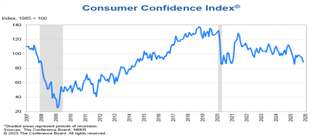
The rising cost of living is also hurting consumer confidence, per the Conference Board’s confidence index; another danger sign. “Consumer confidence weakened for a fifth consecutive month as perceptions of business conditions were negative, and apprehensions about jobs and income deepened,” according to the Conference Board.

Americans blamed their unease on “prices and inflation, tariffs and trade, and politics,” said Dana Peterson, chief economist at the Conference Board.

That is why largest share of consumers—those anticipating that recession is “somewhat likely”—grew again and the small percentage stating that the US is “already in one” crept higher, said Peterson.

Yet the stock indexes are at record highs and the Wall Street rally continues in the hope that AI investments will boost production and bring down the prices of goods and services. Oh goody for the oligarchs!

Many of the low-income workers have only themselves to blame in voting for a man that never intended to improve the lives of workers. His record of bankruptcies to avoid paying investors and workers was well-known before Trump’s first term, so why again?

This administration will soon find out what that means when the other 80 to 90 percent of working Americans realize they have been left behind in this recovery. Actually, maybe the polls are showing they already know.

Harlan Green © 2025

Follow Harlan Green on Twitter: https://twitter.com/HarlanGreen
Posted in Consumers, COVID-19, Economy, Politics, Weekly Financial News | Tagged , , , , , , , , , , , , , | Leave a comment

Equality Is Good For Everyone!

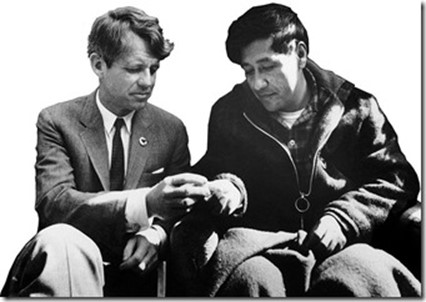
Answering Kennedy’s Call

“And on the tax front, it’s time for rich people like me to pay more.” Mitt Romney

Getty/Bettmann

This quote from a recent NYTimes Mitt Romney Op-ed is my Christmas message: Equal opportunity hasn’t been available to many Americans, even though it is part of the American Dream—America is the land of opportunity that is taught in schools and heard by immigrants.

Why? Because it’s a larger economic truth that not all Americans have accepted. Equality is good for everyone. It should be self-evident, a statement of common sense. The more equality of opportunity among us, the more we can better ourselves, become more productive citizens, which in turn increases our national wealth (and lowers budget deficits).

It was certainly the dream of immigrants, such as my mother, a British citizen born in Jamaica.

But there are times such as today when many Americans don’t believe it is possible, which is why we are living in another Gilded Age with the worst income inequality of the developed world. It is on a par with developing countries in Africa and has been the major cause of recessions and the Great Depression.

Many have bought the counter narrative by those that don’t like equality, such as Donald Trump and his MAGA supporters, part of the privileged few at the top of the income ladder who want us to believe they are the most qualified to create greater wealth for the rest of us.

This Gilded Age was formed like the last Gilded Age of President William McKinley, from a concentration of power among the wealthiest oligarchs. Then it was monopolies in such as the newly created railroad and oil industries.

Today, it is small government policies of Donald Trump that mirror the trickle-down economic policies of President Reagan because enough Americans believed it, believed government was the problem and cutting taxes the solution, believed that equality is not good for everyone because we live in a zero-sum world with limited resources. What is given to one must be taken from another.

The conservative position espoused by 1970s Economist Arthur Okun, for instance, was that greater equality meant less market efficiencies to produce and so fewer incentives for greater wealth, since leveling the playing field meant leveling out the opportunity for large profits. 

But that has never been the case. There has always been copious evidence that the opposite is true; that overly large profits have led to diminished household wealth and breakup of communities.

One can measure inequality with such as the CIA’s World Factbook that ranks inequality among nations. Those with the greatest equality also have less violence, greater freedoms, greater health, and guaranteed vacations!

Richard Wilkinson’s TEDx lecture and book with Kate Pickett, “The Spirit Level” is one of the best studies of the dire effects of income inequality on the quality of life. The most important factor, and a sign of dire consequences when inequality has approached the level of the Great Depression, are the US violent crime and incarceration rates, which Wilkinson discusses at length.

The U.S. is by far the most violent country in the world—worse than any other developed country with the highest incarceration rates. Efforts to reverse such inequality have begun on the local levels, even if congressional conservatives have blocked raising the miniscule national minimum wage of $7.25 per hour that was last set in 2009.

It is worth just $5 per hour today whereas blue states like California and Connecticut have raised their minimum wage to $16.90 per hour in line with rising livings costs.

And there is an increasing awareness of the income disparities, such as the fact that corporate CEOs now earn more than 300 times the income of their employees, and certain hedge fund managers have reported an annual income of $1 billion.

The Center for American Progress launched the Washington Center For Equitable Growth, which aims to deepen the economic critique of inequality. It was set up by Berkeley economist Emmanuel Saez, among others, who is known with his partner Thomas Piketty as the first economists to historically research the history of income distribution over the past 100 years.

The mission statement of the Center explains why it is needed:

“New research suggests that growing inequality in the United States may have broad social and economic effects — by reducing stable demand for goods and services, dampening entrepreneurialism, undermining the inclusiveness and responsiveness of political and economic institutions, limiting access to education, and stunting individual development. Yet our understanding of how these mechanisms interact with the broader economy is limited.”

Mitt Romney’s Op-ed has voiced one of the major issues confronting Americans today—how to fix the overwhelming federal debt load that threatens the ‘full faith and credit’ of the U.S. government.

“The largest source of additional tax revenues is also probably the most compelling for the fairness and social stability. Some call it closing a tax code loophole but the term “loopholes” grossly understates their scale. “Caverns” or “caves” would be more fitting,” said Romney

Donald Trump’s flailing attempts to use higher tariffs to pay down federal debt, when it is in fact another tax on all Americans, is maybe the most important reason to follow Mitt Romney’s advice.

Taxing the wealthiest that haven’t been “paying their fair share”, including Donald Trump’s billionaire supporters, would close one of the largest loopholes that is endangering the U.S. economy, as Senator Bernie Sanders continually reminds us.

Harlan Green © 2025

Follow Harlan Green on Twitter: https://twitter.com/HarlanGreen
Posted in Consumers, COVID-19, Economy, Politics, Weekly Financial News | Tagged , , , , , , , , , , , , , , , , , | Leave a comment

Where is the Inflation?

Financial FAQs

When I took office, inflation was the worst in 48 years, and some would say in the history of our country. President Donald Trump

FREDcpi

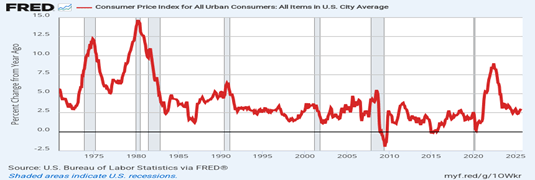
No, just a cursory look at the St. Louis Fed’s above graph of the Consumer Price Index dating from 1970 shows that inflation was much worse 48 years ago. The Arab oil embargo of the 1970s spawned the mother of all stagflations sending inflation to 14 percent in 1980.

The Trump administration is crowing about the weaker November inflation numbers cited in the BLS graph, but who will believe the data when he fired the head of the Bureau of Labor Statistics (BLS) that produces the report because he didn’t like the unemployment revisions in September?

Certainly not consumers, as their sentiment index via the University of Washington sentiment survey has fallen steadily from its high of 74.0 last December to 52.9 this December.

The belief problem was most evident in Trump’s recent prime time, 20-minute Oval Office address quoted above, that showed the leader of our government no longer no longer lives in the real world, only his lies and fantasies.

Whereas the Biden administration had brought it down to 3.0% last December. It only began to rise again since Trump’s April 2 retaliatory tariff announcements.

Perhaps Trump’s biggest lie was that “Much of this success has been accomplished by tariffs. My favorite word tariffs, which for many decades have been used successfully by other countries against us, but not anymore.” and that the tariffs are bringing “billions” back to the American economy.

No, tariffs are an import duty taking money out of the pockets of Americans from the higher prices that have resulted. Though, they could be refunded to the importers that paid the duties if most of the tariffs are repealed by the Supreme Court, as expected. But don’t count on prices coming down anytime soon that have become imbedded since then.

The inflation report was deceptive in that though the overall inflation rate fell to 2.7 percent from 3.0 percent most components rose over the year.

“In November, the Consumer Price Index for All Urban Consumers rose 2.7 percent over the last 12 months, not seasonally adjusted. The index for all items less food and energy increased 2.6 percent over the year (NSA).” BLS

The index for all items less food and energy rose 2.6 percent over the past 12 months, but the shelter index increased 3.0 percent over the last year. Other indexes with notable increases over the last year include medical care (+2.9 percent), household furnishings and operations (+4.6 percent), recreation (+1.8 percent), and used cars and trucks (+3.6 percent).

The most harm to American pocketbooks will be skyrocketing energy prices as the massive build out of AI centers will need tremendous amounts of power. That’s why the energy index for electricity increased 6.9 percent over the last 12 months and the index for natural gas rose 9.1 percent.

Maybe the saddest part of Trump’s address was his nonsensical, desperate hyperbole: “We’re doing what nobody thought was even possible, not even remotely possible. There has never, frankly, been anything like it. One year ago, our country was dead. We were absolutely dead.

Yet the U.S. had the fastest economic recovery in the developed world from the pandemic under Joe Biden with full employment and GDP growth in the 2-3 percent range.

No, we are not dead. And recent political surveys are showing that American voters in recent elections are waking up to the damage being done by Trump and his oligarchs in just one year to the many Americans who have lost jobs, and healthcare coverage, and protection from the worsening floods, wildfires, and hurricanes that Trump calls “a hoax”, all in the name of enriching themselves.

Harlan Green © 2025

Follow Harlan Green on Twitter: https://twitter.com/HarlanGreen
Posted in Consumers, COVID-19, Economy, Politics, Weekly Financial News | Tagged , , , , , , , , , , | Leave a comment

Where Are the Jobs?

Financial FAQs

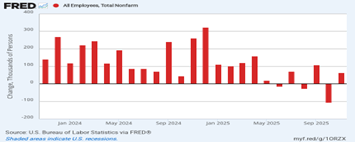
“Total nonfarm payroll employment changed little in November (+64,000) and has shown little net change since April, the U.S. Bureau of Labor Statistics reported today. In November, the unemployment rate, at 4.6 percent, was little changed from September. Employment rose in health care and construction in November, while federal government continued to lose jobs.” BLS

FREDpayrolls

The much delayed ‘official’ U.S. unemployment report for November was actually close to earlier industry predictions from private payroll surveys. A total of 64,000 private payroll jobs were created in November, but just 116,000 jobs have been created since Trump’s April 2 retaliatory tariff announcements—17,000 jobs per month.

More than 200,000 per month were added during the four years of the Biden administration. This is the train wreck that Trump’s economic policies have created from the combination of DOGE government job and spending cuts, and immigrant roundups.

So why have Trump and his Republicans done this much damage to American workers and the American economy? Because the real reason for the tariff wars and government downsizing is to accumulate and centralize all power and wealth to Trump’s oligarchs and the White House.

And Congress hasn’t yet approved any of the tariff agreements that are causing prices to soar on everything.

Healthcare added 46,000 jobs, in line with the average monthly gain of 39,000 over the prior 12 months, construction employment added 28,000 in November, and social assistance continued to trend up in November (+18,000).

But bringing manufacturing home that he touted was one of the main reasons for raising the tariffs, continues to lose jobs.

In November, both the unemployment rate, at 4.6 percent is a four-year high, and the number of unemployed people, at 7.8 million, were higher than last November, when the jobless rate was 4.2 percent, and the number of unemployed people was 7.1 million.

Wall Street’s optimism is keeping stock indexes at record highs because it is betting on next year when consumers see higher tax refunds and corporations higher profits as their new tax benefits (from Big Beautiful Tax Bill) and AI productivity gains kick in.

But who benefits? It’s not hard to guess. It’s the same K-shaped, trickle-down economy once again. A good way to look at it with +3% inflation is that it hurts lower and middle-income folk without assets like homes and stocks that can afford less, while it boosts upper-middle and upper-income folks because rising inflation increases value of the assets they own.

So, the economy will continue to grow, but only for those near the top. Trump is bringing back the Gilded Age of the 1890s that created the corruption and self-dealing of the original robber barons. That is the America he wants to make great again!

“Those at the bottom are living with the cumulative impacts of price inflation,” said Peter Atwater, an economics professor at William & Mary in Virginia cited by MarketWatch. “At the same time, those at the top are benefiting from the cumulative impact of asset inflation.”

When will Americans come to realize what that means and direct their anger at the real thieves?

Harlan Green © 2025

Follow Harlan Green on Twitter: https://twitter.com/HarlanGreen

Posted in Consumers, COVID-19, Economy, Politics, Weekly Financial News | Tagged , , , , , , , , , , , , | Leave a comment

The Great Recession Lesson

Financial FAQs

Irrational Exuberance. Economists who adhere to rational-expectations models of the world will never admit it, but a lot of what happens in markets is driven by pure stupidity – or, rather, inattention, misinformation about fundamentals, and an exaggerated focus on currently circulating stories. Robert J. Shiller

FREDfedfunds

Nobel Laureate Robert Shiller is best known for his book, Irrational Exuberance, that he wrote in 2000 predicting the Dot-com recession. But it applies as well to the Great Recession of 2007-09, the worst world-wide recession since the Great Depression, which was precipitated by the busted housing bubble that in turn was based on the irrational belief housing prices would never fall.

And former Fed Chair Alan Greenspan’s Fed cooperated by pushing its Fed Funds rate to 1% in 2004 per the FRED graph, after which inflation took off. CPI (consumer) inflation ultimately reached 5 percent and Greenspan’s Fed then had to sharply raise its Fed Funds rates to combat it, busting the housing bubble.

The Great Recession that lost more than eight million jobs was ultimately based on President GW Bush pursuing the time-honored Republican agenda of multiple tax cuts and borrowed money while advocating ultra-low interest rates that created the first $1 trillion federal budget deficit.

Sound familiar? Trump is pushing for lower interest rates once again when Chairman Powell’s term at the Fed ends in the spring and his own Fed Chairman takes over with a majority of more inflation-friendly Trump-appointed Governors.

The Great Recession was caused by pure greed, in other words. Republican tax cuts mainly benefited their wealthiest supporters and the higher federal debt was paid for by taxpayers. The Trump administration is running up another $4 trillion to the federal debt from its Big Beautiful Tax Bill renewing the tax cuts enacted during his first term that had already added $5 trillion to the debt.

There were also other lessons from the 2007-09 Great Recession. Bush had championed cutting regulations that ‘freed’ more market speculation and appointed regulators who were in reality foxes in the hen house. They refused to enforce existing regulations, allowing banks to buy and sell junk bonds that were falsely rated as investment grade, causing several investment banks to fail (e.g., Bear Stearns, Lehman Bros).

How close are we to another recession of any kind? The November unemployment report comes out on December 16, as I’ve said, (skipping October’s report) after the Fed’s FOMC meet that decides whether another rate cut is appropriate, so we have only the ‘unofficial’ ADP private payrolls report on employment that showed -32,000 private payrolls were lost in November.

We do have the just out October JOLTS report on monthly hirings and layoffs that said job openings jumped to 7.7 million in October from a 7.2 million reading in August that had been close to a pandemic low.

“Yet the number of people hired in October was basically the same as the number who found jobs in August: 5.1 million. That was the second-lowest number since the pandemic and the lowest since 2015 if the COVID-19 era is omitted,” said MarketWatch’s Jeffry Bartash.

That’s hardly a reason for optimism on future job growth. The fear of higher inflation from the tariffs is causing higher long-term bond and mortgage rates, stopping the housing market from growing at all.

A recession is basically a vote by consumers that they will spend less (because fewer can afford the higher prices, in this case). It’s possible that Republican priorities will fool some of their poorer, MAGA supporters some of the time, but not all Americans.

Yet Donald Trump will continue to pursue more rate cuts when his Fed Governor takes control, telling everyone it won’t cause higher inflation.

This could be the Great Recession scenario all over again, with a deflated AI asset bubble instead of the busted housing bubble. Consumers will know first, even though Trump likes to fire those government statisticians that don’t agree with him and hire incompetents in their place.

There are even more lessons to learn, such as history has a habit of repeating itself when “markets are driven by pure stupidity.”

Harlan Green © 2025

Follow Harlan Green on Twitter: https://twitter.com/HarlanGreen

Posted in Consumers, COVID-19, Economy, Politics, Weekly Financial News | Tagged , , , , , , , , | Leave a comment

Still Flying Blind–Part II

Financial FAQs

“Hiring has been choppy of late as employers weather cautious consumers and an uncertain macroeconomic environment. And while November’s slowdown was broad-based, it was led by a pullback among small businesses.” ADP

wallpaperaccess.com

We know why consumer confidence has plunged to a new post-pandemic low. We have no news of current economic conditions to guide consumers and investors, much less what may happen next, so the U.S. economy is still flying blind.

The November unemployment report comes out on December 16, for instance, (skipping October’s report) after the Fed’s FOMC meet that decides whether another rate cut is appropriate, so we have only the ‘unofficial’ ADP private payrolls report on employment that showed -32,000 private payrolls were lost in November.

The goods sector of the U.S. economy, including Construction and Manufacturing, lost -19,000 jobs. The service sector lost -12,000 overall, though Education, Health and Leisure activities added +46,000 jobs in the sector.

September’s last ‘official’ unemployment report with 119,000 payroll jobs was ok, but that was before the government lock down. And the U.S. economy had averaged just 38,600 new jobs since April and the tariff announcements.

Dr. Nela Richardson Chief Economist, ADP said it best in the survey. Small businesses aren’t hiring because of the uncertain tariffs, since some 90 percent of small businesses import their products that are sold in the U.S.

September retail sales also reported before the shutdown. Retail sales are growing more dependent on a smaller group of consumers. The top 10% of earners in the U.S. accounted for nearly 50% of spending in the second quarter, the highest level it’s been since this data first started being collected in 1989, according to Moody’s Analytics.

And the poor ISM manufacturing index numbers show the manufacturing sector has been contracting for the past nine months.

“A closely followed manufacturing index fell to a four-month low of 48.2% in November from 48.7% in the prior month, the Institute for Supply Management said Monday. Any number below 50% signals contraction,.” MarketWatch

The Federal Reserve will probably lower interest rates another -0.25%, but next year is a rate tossup because of the inflation worries, as almost no tariff agreements have been ratified by congress and signed.

We still have a lot of postponed economic data from the government shutdown, in other words, such as personal consumption and spending data (PCE) that the Fed prefers to measure inflation. We know that annual consumer CPI inflation had jumped to 3% in September, also before the shutdown, and will probably go higher as the tariff costs are passed on to consumers and businesses.

It’s obvious that we are living in uncertain times, and the old Republican playbook of tax cuts combined with DOGE and Project 25 slashing of government benefits are hurting the 90 percent of Americans still living paycheck to paycheck, as I’ve said.

Is that enough to cause a recession, in spite of the stock market’s boost supporting the top 10 percent of Americans that can still afford more than the basic necessities?

It won’t take much to tip US into a recession. The data we need to predict the future will eventually come out. Then we will know if not only the manufacturing sector is contracting—e.g., employment, capital expenditures, and incomes—which are the other major components that determine whether we are in a recession.

Harlan Green © 2025

Follow Harlan Green on Twitter: https://twitter.com/HarlanGreen

Posted in Consumers, COVID-19, Economy, Politics, Weekly Financial News | Tagged , , , , , , , , , , | Leave a comment

Trump Copies Putinism

Popular Economics Weekly

“Russian mathematician and Putin critic Andrey Piontkovsky characterized Putinism as “the highest and final stage of bandit capitalism in Russia; and also as a war, ‘consolidation’ of the nation on the ground of hatred against some ethnic group, attack on freedom of speech and information brainwashing, isolation from the outside world and further economic degradation”. Wikipedia

Medium.com

The latest Ukrainian peace proposal was negotiated between President Trump and Vladimir Putin without Ukraine’s involvement. This is another example of Donald Trump’s attempt to curry favor with Vladimir Putin by literally allowing Putin to dictate the terms of the peace proposal.

Why has Trump turned into Putin’s messenger, whose policies mirror Putinism? Why has the oldest liberal democracy in the world, a nation of immigrants founded on the principle of every member’s inalienable right to be free become the “bandit capitalism” of Vladimir Putin, a dictator who allows no freedoms and kills his own people?

Late-stage capitalism doesn’t fully explain why Donald Trump, a real estate developer with no political experience, could convert a weakened American Democracy into a version of capitalism that concentrates power and wealth in the hands of his oligarchic supporters blatantly ignoring America’s founding principles and laws of the land.

But epidemiologic disease models studied by medical researchers can explain how capitalism could morph into Putinism and bandit capitalism. Such models have shown that there are predictable paths that all epidemics, pandemics, or other contagious disease outbreaks follow from beginning to end.

The body politic of countries and regions (i.e., “the people of a nation, state, or society considered collectively as an organized group of citizens) have endured political outbreaks with similar characteristics. Even civil wars fit this infectious disease model, because they originate internally—brother or sister against each other—and may last longer than years, and suddenly end in unexpected ways.

How do diseases infect? The Black Plague epidemics usually infected people that had been weakened by famines or dysfunctional governments, and the more recent Spanish Flu and COVID-19 pandemics as well that infected and killed millions.

When do such pandemics wane or disappear? They run a recognizable course from inception to a maximum infection rate, then subsided when disease-infected populations eventually found ways to cause their decline. It was quarantines in early times, and vaccines in modern times.

Trumpism, Putinism, and like autocracies or dictatorships have captured weakened political systems. In Russia it was breakup of communism and the Soviet Empire that fostered a Vladimir Putin. In Trump’s case, he took advantage of a democratizing order that had united to win World War II but no longer served many Americans.

Oligarchism, or the Gilded Age model has supported Trump’s version of bandit capitalism with his illegal tariffs that are creating the worst income inequality in the developed world. Trump is promoting a similar hatred of immigrants as Putin, also non-white ethnic and religious groups, attacks on freedom of speech in universities, and Depression-level tariffs that is isolating America from the “outer world”.

The AP just reported that President Donald Trump says he wants to “permanently pause migration” from poorer nations and is promising to seek to expel millions of immigrants from the United States by revoking their legal status. He is blaming immigrants for problems from crime to housing shortages as part of “social dysfunction” in America and demanding “REVERSE MIGRATION.”

He has also followed Putin’s strategy by weakening foreign alliances such as NATO, and breaking up long held foreign trade alliances, all to centralize his power.

But the MAGA movement itself may be in a late-stage decline, as it is slowly disintegrating from internal divisions, with the resignation of major leaders such as Marjorie Taylor Green, growing disputes over policies including tariffs and the treatment of immigrants.

And Donald Trump, its leader, is showing signs of declining health—with fewer public appearances (that also afflicted former president Biden), irrational outbursts and making sudden policy changes without explanation. The MAGA movement has blindly followed him, believing in totally irrational conspiracies until the conspiracies are debunked or and fade away (just as did the flu and COVID-19 pandemics).

The first Gilded Age was defeated by the election of President Teddy Roosevelt riding on the wave of a progressive movement that uncovered the corruption and concentrated wealth of the time.

Trump doesn’t even attempt to hide his blatant corruption nor his promotion of the disease of Putinism that is attempting to destroy American Democracy. So it will take constant vigilance to identify and combat such a widespread contagion, as we have defeated past diseases of the body politic, and bring Americans together once again in common purpose to preserve our democracy.

Harlan Green © 2025

Follow Harlan Green on Twitter: https://twitter.com/HarlanGreen
Posted in Consumers, COVID-19, Economy, Politics, Weekly Financial News | Tagged , , , , , , , , , , , , , , , , , , , , , , , , | Leave a comment

What is Worrying Consumers?

Financial FAQs

“Consumer confidence tumbled in November to its second lowest level since April after moving sideways for several months,” said Dana M Peterson, Chief Economist, The Conference Board. “All five components of the overall index flagged or remained weak.”

Conference Board

Why are consumers worrying so much? Maybe they don’t like government shutdowns? Or, maybe it’s because higher prices and the tariffs are hurting small businesses that depend on imported goods? Or, there are fewer available jobs. Actually, it’s all of the above per the Conference Board’s Consumer Confidence Survey.

“Consumers’ write-in responses pertaining to factors affecting the economy continued to be led by references to prices and inflation, tariffs and trade, and politics, with increased mentions of the federal government shutdown.” Conference Board

It’s also becoming obvious that consumers don’t like bully behavior, such as Republicans ramming through the continuing budget resolution without Democrats’ input.

Republicans were in fact attempting to take down Obamacare (ACA) once again by not including the subsidies in the continuing resolution that made it available for middle and low-income folk, I said last week.

Retail sales data finally released for September showed consumers were still shopping and dining out, but not as much.

So what will happen now? This was all before the shutdown. My guesstimate with anecdotal evidence from the likes of Walmart, Target, et. al., is that the more affluent consumers that own homes and stocks will come storming out of the gates after the shutdown and maybe party through the holidays. Government workers will be receiving extra paydays, for instance—i.e., weeks of backpay.

Doug McMillon, Walmart’s outgoing chief executive, cited by MarketWatch, said on the chain’s earnings call that middle-and-upper-income households drove growth in the U.S. during the third quarter. He also said that “lower-income families have been under additional pressure of late.”

And the financial markets have been rallying as it looks like the Fed will cut rates once again in December. Consumers will rally as well as they race to borrow and purchase during the holidays. That’s because polls say they expect inflation to surge over the next year when things will become more expensive.

And Trump has grown wilier with his tariff pronouncements, not touting their benefits so loudly, for instance, which was alarming consumers, while finally admitting that tariffs have been raising prices. His MAGA followers are suffering the most. He must have finally looked at his poor poll numbers that are even lower than during his first term.

The other unspoken shoe to drop that affects consumers is the shrinking job market. ADP payrolls reports that just +42,000 private payrolls were added in October. Trade, Transportation, Education and Healthcare added the most jobs. But -51,000 jobs were lost in other sectors such as Information and Information and business services.

“Private employers added jobs in October for the first time since July, but hiring was modest relative to what we reported earlier this year. Meanwhile, pay growth has been largely flat for more than a year, indicating that shifts in supply and demand are balanced,” said Dr. Nela Richardson, Chief Economist

It’s pretty obvious that we are living in uncertain times, and the old Republican playbook of tax cuts combined with DOGE and Project 25 slashing of government benefits isn’t yet hurting the 10 percent of consumers that own most things, but that leaves 90 percent of Americans still living paycheck to paycheck.

What will happen to them?

Harlan Green © 2025

Follow Harlan Green on Twitter: https://twitter.com/HarlanGreen
Posted in Consumers, COVID-19, Economy, Politics, Weekly Financial News | Tagged , , , , , , , , , | Leave a comment

U.S.Economy Adds Jobs in September

Popular Economics Weekly

                                    “…while the economy is growing thanks to AI spending, it’s a K-shaped expansion: People who were already affluent are becoming more so, but the less well-off are under severe pressure.Paul Krugman   

FREDnonfarmpayrolls

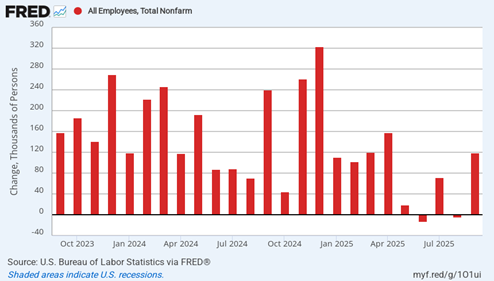
The delayed U.S. unemployment report for September was good old news. It showed 119,000 nonfarm payroll jobs were created, though the unemployment rate edged up to 4.4%. But that was before the government shutdown.

And the U.S. had already lost -13,000 nonfarm payroll jobs in June and -4,000 jobs in August. The U.S. economy has averaged just 38,600 new jobs per month through September since Trump announced the April 2 retaliatory tariffs, as employers haven’t been hiring while they wait see what the final tariff rates (and therefore costs) might be.

The October employment report has been canceled because of the government shutdown and the November report will come out late, depriving the Federal Reserve of critical information before its next meeting to decide whether to cut interest rates again. Both reports were postponed by the 43-day government shutdown that lasted from Oct. 1 to Nov. 12.

So the November employment report will be published on Dec. 16 instead of Dec. 5 as originally scheduled, per the BLS. An estimate of employment for October will be included in the November jobs report. It’s thought that up to 100,000 more government jobs may have been lost in October due to firings or attrition.

It is a K-shaped jobs report, as Nobel Laureate Krugman stated. This is why hiring has stagnated at such a low level since April. Jobs are being created in the lower-paying service sector, whereas the industrial sector and governments are losing jobs.

Employment in food services and drinking places continued to trend up in September (+37,000). In September, social assistance employment continued to trend up (+14,000), reflecting continued job growth in individual and family services (+20,000).

Employment in transportation and warehousing declined by 25,000 in September as job losses occurred in warehousing and storage (-11,000) and couriers and messengers (-7,000). Federal government employment continued to decline in September (-3,000) and is down by 97,000 since reaching a peak in January.

That means the more affluent consumers continued to dine out and could afford more health care services, which is now the fastest growing segment of the economy, as I said.

So the economy is k-shaped because just 10 percent of American consumers are keeping the economy from contracting, because they now own more than 50 percent of assets, according the latest Federal Reserve data—in housing, pensions, and financial assets. And the stock market is still booming.

But small businesses that employ the most workers aren’t hiring because more than 90 percent of them are dependent on imported goods that Trump has targeted with his higher tariffs. We won’t see its effect on economic growth until the fourth quarter and beyond.

If employers aren’t hiring, what is causing the predictions for 4 percent GDP growth in Q3? It’s a statistical fluke because imports are deducted from exports and other domestic expenditures to calculate the overall GDP growth rate. And small business importers are buying less at the moment. The Gross Domestic Product measures what is produced domestically, in other words.

 This is the k-shaped economy we will have to live with. The NYTimes reports that the unemployment rate for 20-24 year-olds has risen to 9.2 percent. The hiring slowdown means they are competing with more experienced workers for fewer available jobs, at least until the tariff rates have settled.

Interest rates? The Fed is scheduled to cut rates another -0.25 percent in December but what if inflation doesn’t come down? Trump has signaled he wants to continue to lower interest rates regardless of the consequences.

Harlan Green © 2025

Follow Harlan Green on Twitter: https://twitter.com/HarlanGreen

Posted in Consumers, COVID-19, Economy, Politics, Weekly Financial News | Tagged , , , , , , , , , | Leave a comment