
Where Are the Jobs?

Popular Economics Weekly

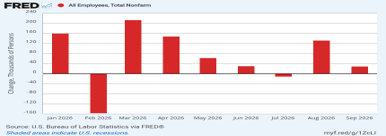
“Both nonfarm payroll employment (+29,000) and the unemployment rate (4.2 percent) changed little in September, the U.S. Bureau of Labor Statistics reported today. Employment in all major industries changed little over the month.” BLS.gov
FREDpayrolls

September’s U.S. official unemployment report was a disappointment—just 29,000 jobs were added vs. +133,000 jobs in August (see graph). But that may not be a sign of a weakening labor market.

It should be obvious that the labor market is at the beginning os another recovery with the massive acceleration in government and A.I. spending that eclipses any prior era by $Billions.

The new chip factories and data centers are being built over time. It may be another decade before we will see definitive results in job formation and GDP growth, as happened in prior technological revolutions, such as for computer and the Internet use to spread.

So it’s difficult to see the changes, contrary to the Bureau of Labor Statistics report, or even the final employment numbers. For instance, after losing -10,000 jobs in July, mainly because of supply disruptions from Trump’s Iran blockade, payroll formation was originally reported to be 162,000 jobs in August then reduced to 133,000 hires in its latest revision.

And I’m guessing that September new jobs will probably be revised upward from 29,000 jobs, given that it’s hard to estimate September because totals include seasonal back to school and government hires that aren’t known immediately.

So, all that investment must eventually grow the job market as well. Steve Ratner, Morning Joe’s resident economist, said in a NYTimes opinion piece that we could already be seeing its impact; the labor markets are beginning to hire more technical professionals because of it.

“To date, A.I. has killed a number of jobs but boosted employment for plumbers, electricians, data scientists and market research analysts”.

Manufacturing may be the biggest story. Manufacturing employment was little changed in September (+9,000) but is up by 72,000 since a recent low in December 2025.

And the Institute of Supply Management’s manufacturing index of new orders climbed 1.6 points last month to a robust 55.3%. It means a majority (55.3%) of supply managers report more new orders. Some manufacturers are even hiring for the first time in a few years. Job creation was positive for the third straight month, following a 33-month streak of declines.

So the low September payroll total may be a temporary glitch.

And GDP growth has already been revised upward in the past two quarters. Q1 2026 GDP was bumped up from 2.0 to 2.2 percent and Q2 from 1.5 to 2.5 percent. And there are +3 percent predictions for Q3 growth.

But all that activity is blowing up inflation. The price index for gross domestic purchases increased 5.6 percent in the second quarter GDP number, revised down 0.2 percentage point from the previous estimate.

This means there will be another Fed rate hike, but maybe after the November election, which is the tradition so as not to be seen as influencing voters.

“Total nonfarm payroll employment changed little in September

(+29,000), following an average monthly gain of 45,000 over the prior 12 months.

Health care employment continued its upward trend in September (+17,000), but at a slower pace than the average monthly gain over the prior 12 months (+33,000).

Will the employment picture improve with literally $Trillions going into the economy? More importantly, will it improve consumers’ confidence in their own future, which has been in the dumps? They must believe so for it to happen. A.I. robots won’t do it.

That is the conundrum, as former Fed Chair Greenspan would say.

Harlan Green © 2026

Follow Harlan Green on Twitter: https://twitter.com/HarlanGreen
Posted in Consumers, COVID-19, Economy, Macro Economics, Politics, Weekly Financial News | Tagged , , , , , , , , , , | Leave a comment

Consumers Holiday Breakout

Financial FAQs

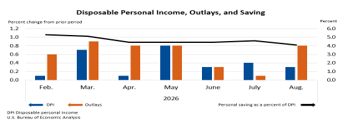
“Personal income increased $66.6 billion (0.2 percent at a monthly rate) in August, according to estimates released today by the U.S. Bureau of Economic Analysis (BEA). Disposable personal income (DPI)—personal income less personal current taxes—increased $68.6 billion (0.3 percent), and personal consumption expenditures (PCE) increased $190.8 billion (0.9 percent).” BEA.gov

I said last week better economic growth depends on the consumer to keep shopping despite the higher inflation and Federal Reserve actions that raise consumers’ cost of living. And there may be at least one more +0.25 percent hike this year.

The rising prices haven’t stopped consumer spending yet. The Federal Reserve’s main consumer measure, the Personal Consumption Expenditure Index (PCE), shows consumers shopping more; maybe because they haven’t run out of savings and want to enjoy the holidays and Christmas?

The jury is out on why they continue shopping. Tariffs and the Iran blockade haven’t stopped them yet, just made it more expensive. But they are depleting their savings because personal incomes, mainly wages, aren’t keeping up with the rising prices.

So what are consumers buying ? Just about everything they need; motor vehicles, energy (gas, diesel fuel) in the face of higher prices, to no one’s surprise.

A big jump in employment (+162,000) last month may also have encouraged consumers to be braver. This month’s unemployment report could be a repeat.

Continued economic growth will also depend on the rest of the economy, of course. Most business investment is with the military and A.I. construction but that won’t help consumers, whose spending makes up two-thirds Gross Domestic Product growth.

Construction is also surging because of the A.I. build out, for instance. That shows up in the S&P Manufacturing Index growth.

“This week’s flash PMI surveys pointed to a sharp acceleration in US activity. The S&P Global US Composite PMI rose from 56.0 in August to 58.4 in September, its strongest reading since July 2021. Both manufacturing and services strengthened, while employment growth accelerated and business costs picked up. S&P Global described the combination as a distinctly hawkish signal for interest rates.”

It could better the mood of consumers. But that’s not enough to sustain their spending for long. The Trump administration has cut back other programs, defying congressional mandates, that would benefit consumers and thus boost longer term growth.

That won’t happen as long as Trump viciously cuts more of the healthcare, education, and environmental protection programs. And the immigration crackdown is depleting many of the service sector jobs that immigrants populate.

We can also say the 7 percent plus fixed mortgage rates have stopped the housing sector in its tracks, further shrinking growth potential.

But consumers might as well make the most of these holidays as long as the good times last!

Harlan Green © 2026

Follow Harlan Green on Twitter: https://twitter.com/HarlanGreen
Posted in Consumers, COVID-19, Economy, Housing, housing market, Politics, Weekly Financial News | Tagged , , , , , , , , , , , | Leave a comment

A ‘Hard Landing’?–Part II

Popular Economics

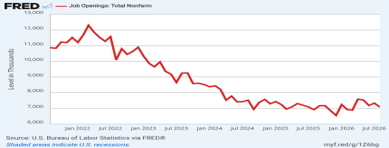
“The number of job openings was little changed at 7.1 million in August, the U.S. Bureau of Labor Statistics reported today. Hires changed little at 5.2 million, while total separations were unchanged at 5.1 million. Within separations, quits (3.1 million) were unchanged, while layoffs and discharges (1.6 million) were essentially unchanged.” BLS.gov

FREDjolts

Will the federal Reserve engineer a hard or soft landing in this new rate hike cycle just beginning? A soft-landing is possible, but something has to be done about the rapid rise in interest rates.

The last time the Fed acted to tame inflation was during the post-COVID-19 pandemic recovery when CPI inflation had reached 9 percent.

But it worked. There wasn’t another recession and the economy has had five years of continuous growth since then, in large part because of the bipartisan recovery aid, including personal checks paid to almost all Americans.

More than $5Billion was invested in the recovery from the worst recession since the Great Depression.

Can the Fed do a repeat performance under new Fed Chair Kevin Warsh, an actual economist?

The just released JOLTS report shows that better economic growth is ahead, even with the Fed’s first rate hike since 2024. The actual unemployment report is due and will give more clues—such as whether hires pick up.

So the hard landing scenario—which is an engineered recession, when the Fed holds interest rates too high for too long, I believe is less likely even though bond interest rates are the highest in 20 years; a danger single that credit conditions are tight for both businesses and consumers.

The Jobs Openings and Labor Turnover survey shows the number of job openings has been gradually increasing from its low of 6.55 million openings last December and is now 7.1 million.

There were 5.2 million hires and 5.1 million separations (i.e., quits), thus approximately 100,000 net new jobs were possibly created in August. This should be positive news for the upcoming August unemployment report.

If higher job formation continues, consumers will spend more despite the Fed’s actions to raise their higher borrowing costs. Consumers aren’t feeling good about the cost of anything since the Iran war.

They will need a confidence boost. They aren’t very happy per the latest Conference Board survey.

“The Consumer Confidence Index deteriorated notably in September, following two prior months of softening,” said Dana M Peterson, Chief Economist, The Conference Board. “The Present Situation Index fell sharply, while the Expectations Index slipped further into negative territory.”

But higher job creation numbers might do the trick and allow a soft landing, especially if the A.I. build- out will create the good jobs that are needed to run the new economy.

Harlan Green © 2026

Follow Harlan Green on Twitter: https://twitter.com/HarlanGreen
Posted in Consumers, COVID-19, Economy, Politics, Weekly Financial News | Tagged , , , , , , , , , , , | Leave a comment

Higher Economic Growth?–Part II

Financial FAQs

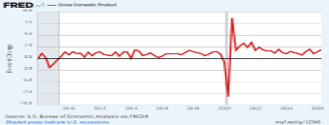
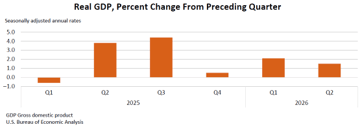
“Real gross domestic product (GDP) increased at an annual rate of 1.5 percent in the second quarter of 2026 (April, May, and June), according to the second estimate released today by the U.S. Bureau of Economic Analysis (BEA). In the first quarter, real GDP increased 2.1 percent.” BEA.gov

FREDgdp.

I don’t believe a recession is about to happen, I said last week. The five-year cycle of economic growth begun with the recovery from the Covid-19 pandemic could continue.

For how long? The longest growth cycle to date was during the Obama and Trump I administrations—2009 to 2020 (see above graph). And that was because of the massive government spending to bring U.S. out of the 2008-09 Great Recession.

This is despite Trump’s economic wrecking ball that has reduced nonfarm payroll formation to just 31,000 per month over the past year and canceled or reduced many of President Biden’s bipartisan bills that boosted investment in infrastructure, healthcare, environmental protection, and healthcare services.

And what about the Fed’s rate hike(s)? Barron’s Randall Forsyth reports that interest rate markets believe the Federal Reserve risks causing a recession, or stagflation at least, by raising its Fed Funds rate +0.25 percent one to two more times to fight very stubborn inflation.

That is why economic growth slowed to 2.1 percent and 1.5 percent in Q1 and Q2 this year that the Fed could further damage because of its hawkish rhetoric on inflation.

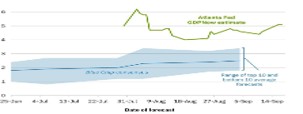
But something remarkable is happening that could pull Americans away from the precipice. The Atlanta Fed’s GDPNow estimate of third quarter GDP growth is 5.1 percent for the second consecutive month, above most economists’ predictions.

Why? Consumers and governments are on a spending spree, and some $800B is being invested in the construction of A.I. data centers blanketing the country where many Americans don’t want them.

This is while corporations have record profits, which will extend the record stock market run whose prices are already in nosebleed country. The Price-to-Earnings ratio of the S&P 500 is 28 to 1, already far above its long term 15 to 1 historical ratio, according to Nobel Economist Robert Shiller of irrational exuberance fame.

Trump and Republicans can’t do much more damage to growth. Their policies are failing at almost everything they attempt. Trump’s signature tariffs are illegal and require refunding, which will aid the bottom line of corporations and lower the prices of such as Target and Walmart.

He has failed to win the Iran war, and the world is finding ways to work around the consequent energy shortages. This is in part because renewable energy sources are making a comeback. The Japanese have even agreed to build small nuclear reactors and two huge natural gas energy projects in the Midwest and South.

Consumers haven’t stopped spending, either. Surprisingly, American retail shoppers are out in force again with the 1.2 percent August sales increase. Many consumers seem to be recovering from the shock to energy prices since the beginning of the Iran War.

And maybe payroll hiring will continue to improve with the 166,000 new hires in August. But the bottom line is the Iran war must end as well, and everyone knows it.

Harlan Green © 2026

Follow Harlan Green on Twitter: https://twitter.com/HarlanGreen
Posted in Consumers, COVID-19, Economy, Politics, Weekly Financial News | Tagged , , , , , , , , , , , | Leave a comment

More Economic Growth Ahead

Financial FAQs

“The GDPNow model estimate for real GDP growth (seasonally adjusted annual rate) in the third quarter of 2026 is 5.1 percent on September 17, unchanged from September 16 after rounding. After this morning’s housing starts release from the US Census Bureau, the nowcast of third-quarter real residential investment growth decreased from -4.3 percent to -4.7 percent.”

GDPNow

The five-year plus cycle of business growth that began after the COVID-19 recession could continue years. I have become much more upbeat about our economic future.

All signs are pointing to a large jump in economic growth for several years, despite the geopolitical chaos. Why? Trump and Republican actions may not be as damaging to the world economies from his tariffs and desire to create a second Gilded Age that has created the many robber barons and massive concentration of wealth.

The massive A.I. investments and stock market highs say that it could continue despite the reordering of world markets amid so much geopolitical uncertainty. This could outweigh the effects from tariffs and the unending Iran war that continue to elevate inflation. Growth isn’t being boosted by just the A.I. build out that is projected to cost some $800B, more than all residential real estate investment.

The Atlanta Fed’s GDPNow estimate of third quarter GDP growth is 5.1 percent for the second consecutive month, above most economists’ predictions. Consumers and governments are on a spending spree, as well as the construction of A.I. data centers that are blanketing the country.

The longest positive growth cycle to date was during the Obama and Trump I administrations—2009 to 2020, slightly eclipsing the 1990’s Clinton era that ended with four years of budget surpluses.

The manufacturing and service sector activity as measured by the latest Institute of Supply Management indexes are still expanding, causing long-term interest rates to rise as well.

“In August, the Services PMI® registered 55.4 percent, an increase of 1.3 percentage points compared to July’s figure of 54.1 percent. The Business Activity Index remained in expansion territory in August, increasing 2.6 percentage points to 61.7 percent from July’s reading of 59.1 percent.”

“The Manufacturing PMI® registered 54.6 percent in August, 1 percentage point below the July figure of 55.6 percent. The overall economy continued in expansion for the 22nd month in a row. (A Manufacturing PMI® above 47.5 percent, over a period of time, generally indicates an expansion of the overall economy.)” 

S&P also chimed in with its composite output index growing the fastest in five years. But will it withstand the Federal Reserve rate hike cycle just begun, with maybe a second rate boost this year?

The key to prolonging this business cycle is also the labor market, which has been subpar until now. The August 162,000 nonfarm payroll employment was a total surprise, given the average monthly gain of just 31,000 over the prior 12 months.

And American shoppers are out in force for the first time this fall as they rushed to get ahead of rising prices for the holidays, I said last week.

So corporations must keep hiring and not be deterred by the looming fear of A.I. robots supplanting those jobs.

Harlan Green © 2026

Follow Harlan Green on Twitter: https://twitter.com/HarlanGreen
Posted in Consumers, COVID-19, Economy, Housing, housing market, Politics, Weekly Financial News | Tagged , , , , , , , , , , | Leave a comment

Will It Be a ‘Hard Landing’?

Popular Economics

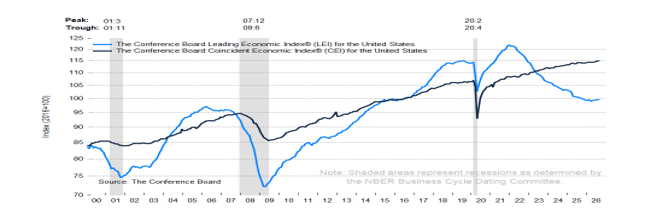
“The US LEI receded slightly in August, the first monthly decline since March of this year,” said Justyna Zabinska-La Monica, Senior Manager, Business Cycle Indicators, at The Conference Board. “Four out of ten components fell compared to the previous month, with consumer expectations remaining a significant strain on the Index.”

LEI

Does the new Fed chairman want to be another Paul Volcker, whose Board of Governors raised the Fed Funds rate to 20 percent to cure the stagflation surge of the 1970s? We don’t need another ‘hard landing’, the economic term for an engineered recession.

New Fed Chair Kevin Warsh said at the most recent FOMC meeting that the Fed would do what it takes to restore confidence in the Federal Reserve to fulfill its mandate of low inflation with maximum employment.

And to make its point the 12 Fed Governors voted unanimously to raise their Fed Funds rate +0.25 percent, thus raising the Prime Rate from 6.75 to 7.00 percent that governs most installment loan and credit card rates.

So the surge in August retail sales might not be a good thing, as much as consumers would like to celebrate another good holiday, since how is the Fed to bring down inflation otherwise when consumers are a major cause of it?

The core personal consumption expenditure index—the version of the Fed’s preferred inflation measure for consumers that excludes food and energy prices—has exceeded the Fed’s 2% target for over 60 months.

The Conference Board’s Index of Economic Indicators (LEI) that attempts to predict future growth has been flashing signals of a slowdown for months per its graph above (downward slope of blue line).

But even the tariffs and Mideast wars haven’t slowed down consumer spending enough. The Fed is saying that it has waited too long to act to bring down inflation, which is endangering economic growth and the U.S. currency.

Chairman Warsh also said five years was too long to wait for the inflation rate to return its 2 percent target rate because of the tariffs and Middle East unrest. It was last this low during the COVID-19 pandemic.

Of course, “The odds of a serious Fed policy mistake are uncomfortably high and rising,” warned Mark Zandi, chief economist at Moody’s Analytics, in a post on X, I quoted last week.

Barron’s Randall Forsythe cites David Rosenberg of Rosenberg Research on what can be the most dangerous mistake, “Unless oil prices come down quickly. The only way by which interest rates bring inflation back to the 2% target is “by destroying enough demand to offset the supply loss. That is a recession by design,” he concludes.

Economists call it a ‘hard landing’. And that has always been the dilemma; how can the Fed boost interest rates just enough to engineer a ‘soft landing’, which means bring inflation back down to its long-term average without causing a recession?

This is the rock and a hard place I’ve been talking about. It can’t be done without some pain.

Harlan Green © 2026

Follow Harlan Green on Twitter: https://twitter.com/HarlanGreen
Posted in Consumers, COVID-19, Economy, Macro Economics, Politics, Weekly Financial News | Tagged , , , , , , , , , , , | Leave a comment

Good Retail Sales

Financial FAQs

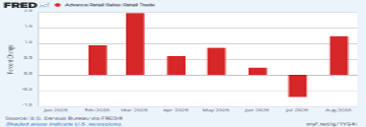
“Advance estimates of U.S. retail and food services sales for August 2026, adjusted for seasonal variation and holiday and trading-day differences, but not for price changes, were $773.9 billion, up 1.2 percent (±0.4 percent) from the previous month, and up 6.0 percent (±0.5 percent) from August 2025.” Census Bureau

FREDretailsales

What a difference in just a month! I was overly pessimistic earlier this year when consumers’ confidence was declining on how consumers would behave during the holidays because of the energy shortages and higher tariffs.

Surprisingly, American shoppers are out in force for the first time this fall after several pauses as they rushed to get ahead of rising prices for the holidays.

Retail sales jumped +1.2 percent in August after declining -0.7 percent in July. That’s a huge rise with some inflation indexes above 5 percent. It seems homeowners and investors benefiting from the financial markets can afford more dining out and leisure travel these days.

For good reason. The 162,000 new payroll jobs tallied in August may have emboldened them after miniscule job gains the prior three months. Add in that third quarter economic growth predictions are now clustered around 4 percent because of the A.I. build out and record corporate profits after very meek growth in Q1 and Q2.

The August 162,000 total nonfarm payroll employment was a total surprise, given the average monthly gain of just 31,000 over the prior 12 months. Why the sudden rise? These are largely new service sector jobs, which means summertime travel and leisure activities pick up, schools will soon begin, and nonresidential construction of the A.I. data centers is going full speed.

Employment in food services and drinking places increased by 59,000 in August, well above the average monthly gain of 12,000 over the prior 12 months as well. Local government education added 42,000 jobs in August, offsetting a decrease in the prior month.

Will this reverse the severe job decline since early 2024 at the start of the second Trump administration? It will depend on how consumers are feeling about the economy as I said.

They aren’t feeling that well at present. According to Joanne Hsu, the University of Michigan sentiment survey Director:

“Democrats and Republicans alike posted sizable declines (in sentiments), while independents were little changed from August. Year-ahead expectations for both personal finances and business conditions plunged. With a resurgence in fuel prices and trade tensions, consumers anticipate greater pressures on their pocketbooks to come.”

But this is before the new tariffs on our largest trading partner’s Canadian exports kick in that will boost construction costs and vehicle prices even higher.

Maybe some consumers want to enjoy the present while they can rather than worry about the future and what the $trillions being invested in A.I. might do to the job market. What do they know?

LATE BULLETIN—The Federal Reserve just announced a +0.25 percent raise in their Fed Funds rate for the first time in three years, with maybe more raises to come because of the worsening Mideast conflict.

Harlan Green © 2026

Follow Harlan Green on Twitter: https://twitter.com/HarlanGreen
Posted in Uncategorized | Tagged , , , , | Leave a comment

What’s the Fed To Do?

Popular Economics

“Real gross domestic product (GDP) increased at an annual rate of 1.5 percent in the second quarter of 2026 (April, May, and June), according to the second estimate released today by the U.S. Bureau of Economic Analysis (BEA). In the first quarter, real GDP increased 2.1 percent.” BEA.gov

FREDgdp

Economic growth has slowed because of too much economic and geopolitical uncertainty that shows no signs of relenting. So, there are growing warnings that the Federal Reserve might be raising interest rates too soon in September.

“The odds of a serious Fed policy mistake are uncomfortably high and rising,” warned Mark Zandi, chief economist at Moody’s Analytics, in a post on X.

What mistakes? Like raising interest rates too soon to anticipate events that might not even happen. Dr. Zandi is commenting about a fear that the Fed will act too soon to curb the growing inflation surge, thus slowing economic growth unnecessarily in the face of more events that may require easier credit conditions.

I’m also on the side of caution. The record highs in financial markets fit all the signs of past investment bubbles. Therefore, raising interest rates prematurely may burst the investment bubble as it did the housing bubble that created the Great Recession.

The argument to hold rates or even lower them is because Trump’s tariffs have already reduced consumers’ pocketbooks. The $billions in refunds ordered by the courts from the illegal tariffs have mostly benefited major retailers such as Target.

Or, the Fed may be right to raise their rates now because inflation won’t slow down and the financial markets are at record levels, which will goose economic growth for probably the rest of this year.

That’s why inflation indexes like the wholesale PPI inflation gauge are trending above 5 percent while countries are already experiencing energy shortages amid two ongoing wars.

Economic growth is picking up from the A.I. build out as well, which means inflation won’t come down of its own accord. There are predictions that third quarter GDP growth may be as high as 4 percent due to record corporate profits and the A.I. build out frenzy.

The often cited Atlanta Fed’s GDPNow third quarter growth prediction has been above 4 percent since it was initiated in mid-summer, mostly due to predictions that robust consumer spending and domestic investments will continue.

“Real final sales to private domestic purchasers, the sum of consumer spending and gross private fixed investment, increased 4.2 percent in the second quarter, revised up 0.3 percentage point from the previous estimate,” the BEA chimed in.

Another inflation gauge, the price index for gross domestic purchases per the BEA announcement increased 5.8 percent in the second quarter, revised up 0.1 percentage point from the previous estimate. The personal consumption expenditures (PCE) price index increased 5.3 percent, revised up 0.2 percentage point, and the PCE price index excluding food and energy increased 3.6 percent, also revised up 0.2 percentage point.

These are more inflation measures that say inflation will require years to come back down to the Fed’s 2 percent inflation target. There aren’t yet ceasefires being negotiated in both wars, much less endings, and Trump keeps attempting to raise his illegal tariffs!

So the Fed is between the classic rock and a hard place. Raising rates will slow growth from the A.I. data center build out, while maintaining or lowering rates will keep consumers spending and the job market from collapsing.

But the Fed’s inflation mandate is in direct conflict with Trump administration policies that want to keep interest rates as low as possible to pay for its tax cuts and policy mistakes.

So why not be extremely cautious and protect yourself from all the possible disasters looming on the horizon? Or leave it to the Federal Reserve Governors to be the canaries in the coal mine.

Harlan Green © 2026

Follow Harlan Green on Twitter: https://twitter.com/HarlanGreen

Posted in Consumers, COVID-19, Economy, Politics, Weekly Financial News | Tagged , , , , , , , , , , , , | Leave a comment

Inflation Out of Control?

Popular Economics

The Producer Price Index for final demand moved up 0.4 percent in August, seasonally adjusted, the U.S. Bureau of Labor Statistics reported today. On an unadjusted basis, the index for final demand increased 5.4 percent for the 12 months ended in August. BLS.gov

FREDppi

The FRED graph makes it painfully obvious just what illegal tariffs and wars are doing to wholesale prices and will be passed on to retail prices for finished goods in the years to come.

It means just that. Inflation at the wholesale level takes time to change retail (CPI) prices; maybe a long time. Inflation is a measure of the behavior of prices, and seldom do they point in a downward direction, unless there’s a surplus of supply, or a shrinking in demand due to job losses or too much debt, or, there’s an outright recession.

The slight drop in the June/July 2025 was because of the 60-day cease fire, so we can imagine how settling the Iran war could improve inflation. But, alas, Trump is lying when he says the war is no big deal, as if choking off Middle East oil and gas supplies in definitely won’t matter.

Yet we know it could morph into an endless war that does great damage to world economies, as did the OPEC oil embargo of the 1970’s that turned into a decade of stagflation.

The current inflation surge is mainly in goods rather than the service sector—things rather than services. The index for final demand goods (such as computers and chips) advanced 1.1 percent in August following two consecutive decreases (June-July). Over three-fourths of the broad-based rise can be attributed to energy prices, which moved up 4.2 percent.

But the Consumer Price Index was released the following day, in which the index for gasoline rose 3.9 percent in August, accounting for over one third of the monthly all items increase.

And we now must add in the additional tariffs on imported Canadian oil, steel, lumber and electrical goods, which makes it even more likely the Fed will raise interest rates this month. But that won’t help in the near term.

In attempting to squeeze Iran’s economy with the Strait of Hormuz blockade Trump and Iran are squeezing other economies as well!

It’s like two punch-drunk fighters in the ring with no one able to deliver the knockout punch.

This is in fact looking more like a repeat of the 1970’s stagflation when the U.S. was locked in a struggle with OPEC, and inflation rose as high as 14 percent with two recessions plus two more in 1980-81 that were caused by the cure; raising the Fed’s own rates to 20 percent.

Do we want a repeat? I don’t think so. We are once again engaged in an endless war and seemingly endless inflation spiral unless Republicans join Democrats to stop the carnage.

Harlan Green © 2026

Follow Harlan Green on Twitter: https://twitter.com/HarlanGreen

Posted in Uncategorized | Tagged , , , , | Leave a comment

Jobs Picture Improves?

Financial FAQs

“Total nonfarm payroll employment increased by 162,000 in August, and the unemployment rate was unchanged at 4.1 percent, the U.S. Bureau of Labor Statistics reported today. Employment increased in food services and drinking places and in local government education. The information industry lost jobs.” BLS.gov

FREDpayrolls

Total nonfarm payroll employment rose by 162,000 in August, higher than the average monthly gain of 31,000 over the prior 12 months, said the Bureau of Labor Services.The new payroll jobs tallied in August look to be a temporary blip after miniscule job gains the prior three months.

Why the sudden rise? These are largely service sector jobs, which means summertime travel and leisure activities pick up, and schools will soon begin.

Employment in food services and drinking places increased by 59,000 in August, well above the average monthly gain of 12,000 over the prior 12 months. Local government education added 42,000 jobs in August, offsetting a decrease in the prior month.

Will this reverse the severe job decline since early 2024, the start of the second Trump administration, that is portrayed in the Federal Reserve Bank of St. Louis (FRED) graph above?

Only if Trump will cease finding ways to illegally raise tariffs, begin to honor existing tariff agreements, and settle the Iran war that he is mired in. Oh yes, also stop the immigration policies that have depleted the number of working adults.

Otherwise, the one million fewer working adults who have stopped looking for work, thus shrinking the labor force, will also shrink economic growth.

The FRED graph is an accurate depiction of what a gutted labor market looks like since 2024. There is no consistency, because it reflects the moment-to-moment thoughts, or lack of thoughts, of a President who rules by distraction to shield the damage to economic growth he and Republicans are causing.

It’s a huge damage list—+300,000 federal jobs cuts by DOGE, downsizing or eliminating whole departments in Health and Human Services, the EPA, Medicare and Medicaid that hurts worker productivity by creating a sicker working population.

The bond rout (NYTimes) that is raising longer term interest rates has scared our allies. Both the Dutch and French governments have elected to remove their $billions in gold assets out of U.S. territory, where they have been traditionally held because they no longer trust the U.S. to keep international agreements.

Will other countries begin to sell off their U.S. holding of Treasury bonds as well? That would be a major red flag, as it means other countries are turning away from using the U.S. Dollar that supports most world trade.

Nobel Laureate Paul Krugman doesn’t think it’s a danger just yet.

“I’m not saying that Democrats should be like Trump, and blithely ignore debt and deficits. They should by all means push for tax hikes on high incomes, close loopholes exploited by multinational corporations, strengthen IRS enforcement, and more.” 

The economic uncertainty could also be a result of Trump’s own deteriorating mental state and three more years of endless military wars. We will need our allies.

Harlan Green © 2026

Follow Harlan Green on Twitter: https://twitter.com/HarlanGreen

Posted in Consumers, COVID-19, Economy, Macro Economics, Politics, Weekly Financial News | Tagged , , , , , , , , , , , , , , , | Leave a comment